
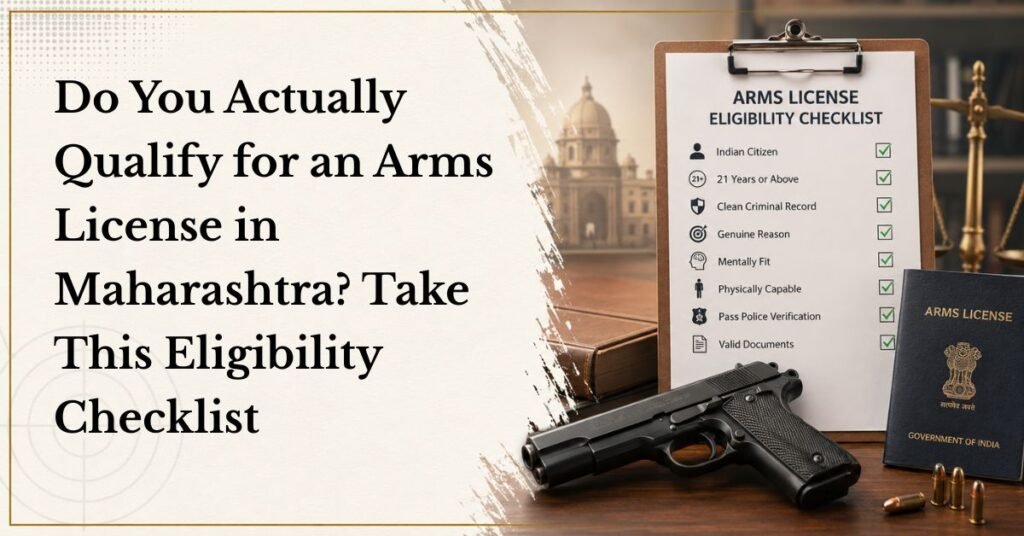
Quick Summary: Getting an arms license in Maharashtra isn’t about luck or connections; it’s about meeting clear legal, documentary, and character-based benchmarks under the Arms Act, 1959. This guide gives you a 20-point self-assessment checklist, busts common eligibility myths, and shows you exactly what to fix if you fall short so you apply with confidence instead of guesswork.
If you have ever searched for “arms license eligibility in Maharashtra” and come away more confused than when you started, you are not alone. Between conflicting information on forums, outdated blog posts, and well-meaning but inaccurate advice from acquaintances, most first-time applicants have no real idea whether they even qualify before they walk into a District Magistrate’s or Police Commissioner’s office.
This guide fixes that. Below is a practical, honest, self-assessment checklist based on the framework of the Arms Act, 1959 and the Arms Rules, 2016, written in plain language, so you can evaluate your own eligibility before you invest time in the application process.
Table of Contents
ToggleWho Is Legally Eligible for an Arms License in India?
Under Indian law, an arms license is not a right it is a privilege granted at the discretion of the Licensing Authority (typically the District Magistrate or Deputy Commissioner of Police, depending on your jurisdiction) after verifying that the applicant meets specific legal and procedural conditions.
Broadly, to even be considered, an applicant must satisfy these baseline requirements:
- Age: The applicant must generally be 21 years or older. Exceptions exist in limited circumstances, but minors cannot independently hold a license.
- Sound mind: The applicant must not have been declared of unsound mind by a competent court or medical authority.
- No disqualifying criminal history: The applicant must not have been convicted of an offence involving violence, moral turpitude, or under laws such as the Arms Act itself, NDPS Act, or similar statutes.
- No pending criminal proceedings of a serious nature that would indicate a risk if a weapon were granted.
- Genuine and justifiable need: This is the single biggest filter. The applicant must demonstrate a real, specific reason for self-defence due to a credible threat, business necessity (jewellers, cash handlers), agricultural protection (crop or cattle protection from wildlife or theft), or professional requirement (security personnel, sports shooters).
- Not a threat to public peace or security: The Licensing Authority evaluates whether granting a license could endanger public safety.
- Compliance with local police verification: A clean report from local police, including character and antecedent verification, is mandatory.
Meeting these conditions does not guarantee approval, but failing even one of them makes rejection almost certain.
The Complete Self-Assessment Eligibility Checklist
Answer each question honestly with a Yes or No. This is the same type of scrutiny a Licensing Authority and a verifying police officer will apply to your file.
Section A: Basic Legal Eligibility
- Are you at least 21 years of age? (Yes/No)
- Are you an Indian citizen? (Yes/No)
- Do you have a permanent or long-term residential address within Maharashtra, with valid proof? (Yes/No)
- Have you never been declared of unsound mind by a court or certified medical authority? (Yes/No)
- Do you have no conviction for any criminal offence involving violence, moral turpitude, or arms-related violations? (Yes/No)
- Do you have no ongoing serious criminal case, FIR, or preventive action registered against you? (Yes/No)
- Have you never had a previous arms license suspended, cancelled, or revoked due to misconduct? (Yes/No)
Section B: Genuine Need Assessment
- Can you clearly explain, in writing, why you need a firearm (self-defence, business, agriculture, sport, or profession)? (Yes/No)
- If claiming a threat to life, do you have supporting evidence such as a police complaint, FIR, or documented threat? (Yes/No)
- If applying as a business owner, jeweller, or cash handler, can you show proof of business ownership, turnover, or cash-handling volume? (Yes/No)
- If applying as a farmer, do you own or lease agricultural land, and can you demonstrate wildlife or security-related risk to crops/livestock? (Yes/No)
- If applying as a security professional, do you hold a valid employment or contractual document from a recognised security agency or organisation? (Yes/No)
Section C: Character and Community Standing
- Are you free from habitual alcohol or substance-related complaints on police record? (Yes/No)
- Have you maintained a stable residence (not frequently shifting without documentation) for a reasonable period? (Yes/No)
- Are you currently employed, self-employed, or able to demonstrate a legitimate source of income? (Yes/No)
- Do you have at least two credible references/witnesses who can vouch for your character during police verification? (Yes/No)
Section D: Procedural Readiness
- Do you have access to your identity and address proof documents (Aadhaar, PAN, voter ID, etc.)? (Yes/No)
- Are you willing and prepared to undergo police verification, including a home visit? (Yes/No)
- Are you free of any pending litigation that could affect your character certificate? (Yes/No)
- Are you prepared to specify the type of weapon and its intended use accurately in your application? (Yes/No)
How to interpret your answers: If you answered “No” to any question in Section A, you are currently ineligible and must resolve that issue before applying. A “No” in Sections B, C, or D does not always mean disqualification, but it significantly weakens your application and should be addressed first.
Common Reasons Applicants Become Ineligible
Understanding why applications fail is often more useful than knowing the rules themselves. The most frequent disqualifying or weakening factors include:
- Vague justification. Writing “for self-protection” without specific incidents, threats, or documentation is one of the most common reasons for rejection.
- Undisclosed criminal history, even for minor or old offences, discovered during police verification.
- Frequent change of address without updated documentation, which raises verification red flags.
- Unverifiable business claims for example, claiming to be a jeweller or cash handler without GST registration, shop licenses, or financial records.
- Poor local reputation or unresolved disputes, including property or family disputes that surface during the neighbourhood verification process.
- Incomplete or inconsistent documentation across application forms, affidavits, and supporting proofs.
- Applying for the wrong category of license, for instance, applying for a “self-defence” license when the actual need is business-related, which requires different supporting evidence.
Myths About Arms License Eligibility
Myth 1: “Anyone can get an arms license if they simply apply and pay the fee.” False. The license is discretionary, not automatic. Payment of fees only follows approval; it does not guarantee it.
Myth 2: “Owning a business automatically qualifies you.” Not accurate. Business ownership alone is not sufficient you must demonstrate a specific, verifiable risk tied to that business, such as handling large sums of cash or valuables.
Myth 3: “A license once granted lasts forever with no scrutiny.” Incorrect. Licenses are subject to periodic renewal, and continued eligibility (including clean conduct) is reassessed at each renewal.
Myth 4: “If you know someone in the police department, approval is guaranteed.” This is both false and risky. Genuine eligibility, documentation, and verification outcomes are what determine approval, not personal connections.
Myth 5: “Self-defence licenses are given to anyone who feels unsafe.” A general feeling of insecurity is not sufficient. Authorities look for demonstrable, specific threat perception, often supported by police records or documented incidents.
Myth 6: “Farmers automatically qualify because of crop protection needs.” Land ownership helps, but the applicant must still show a credible pattern of risk such as wildlife intrusion, theft, or remote/isolated farmland and pass the same character checks as any other applicant.
Real-Life Scenarios: Are They Eligible?
Scenario 1 — The Jeweller in Pune: A 45-year-old jeweller runs a registered shop, deals in high-value gold transactions, and has GST records showing significant daily cash and stock movement. He has no criminal record. Likely eligible, provided he documents the value of stock/cash handled and the specific security risk.
Scenario 2 — The Individual With a Vague Fear: A 30-year-old professional wants a license because “the area feels unsafe at night,” with no police complaint or specific incident on record. Currently weak/likely ineligible until a documented threat or incident is established.
Scenario 3 — The Farmer With a Pending Land Dispute: A farmer owns land in a rural part of Maharashtra but is currently involved in an unresolved property dispute with a neighbour, including a police complaint against him. Likely ineligible for now; the pending dispute will surface in verification and needs resolution first.
Scenario 4 — The Security Professional: An employee of a licensed private security agency, tasked with escorting cash-in-transit vehicles, has a valid employment contract and a clean record. Likely eligible, supported by an employer certificate confirming the role.
What to Do If You’re Currently Not Eligible
Ineligibility today does not mean ineligibility forever. If your self-assessment revealed gaps, consider the following steps:
- Resolve pending legal matters — settle disputes, clear old cases, or obtain documentation showing resolution.
- Strengthen your justification — file a formal police complaint if you’re facing a genuine threat, rather than relying on informal claims.
- Formalise your business records — ensure GST registration, shop licenses, and financial documentation are current and consistent.
- Maintain a stable, documented address for a reasonable period before applying.
- Build a clean, verifiable track record — community standing and consistent employment history matter during police verification.
- Consult a professional before applying — an incorrect or premature application can create a rejection history that complicates future attempts.
Documents to Keep Ready
Regardless of your specific eligibility category, understanding the documents required for a gun license in Maharashtra in advance can save you weeks of back-and-forth during verification. Most applicants are expected to have the following ready and organised before they apply:
- Identity proof (Aadhaar card, PAN card, passport, or voter ID)
- Address proof (utility bill, rent agreement, or property documents)
- Recent passport-sized photographs
- Proof of occupation/income (salary slips, business registration, ITR, GST certificate)
- Character certificate or references
- Medical fitness certificate, where applicable
- Supporting evidence for “need” (FIR copy, threat documentation, business turnover proof, land ownership documents, employment contract, etc.)
- Any previous license-related documents, if applicable (renewals, past applications)
- Affidavits as required by the specific Licensing Authority
Frequently Asked Questions
- What is the minimum age to apply for an arms license in Maharashtra?
The general minimum age is 21 years, as prescribed under the Arms Rules.
- Can a person with a past criminal case get an arms license?
It depends on the nature of the case. Convictions involving violence or moral turpitude typically disqualify an applicant, while minor, resolved, or unrelated matters may be evaluated individually.
- Do jewellers automatically qualify for an arms license?
No. Jewellers must demonstrate genuine, documented risk such as high-value stock or cash handling rather than relying on occupation alone.
- Is a self-defence license available to everyone who feels unsafe?
No. A general sense of insecurity is not enough; applicants must show specific, credible threat evidence, often supported by police documentation.
- Can farmers get arms licenses for crop protection?
Yes, this is a recognised category, but the applicant must show land ownership, a pattern of risk (such as wildlife intrusion or theft), and pass standard character checks.
- How long does the arms license verification process take in Maharashtra?
Timelines vary by district and case complexity, as verification involves local police, character checks, and administrative review.
- Can a license be rejected even if all documents are submitted?
Yes. Documentation alone doesn’t guarantee approval the Licensing Authority also evaluates genuine need, public safety considerations, and verification outcomes.
- What disqualifies someone from getting an arms license in India?
Common disqualifiers include criminal convictions, pending serious cases, unsound mind declarations, vague or unverifiable justification, and poor police verification outcomes.
- Is a threat perception report mandatory for a self-defence license?
While not always mandatory in every jurisdiction, documented evidence of threat (such as an FIR or police complaint) significantly strengthens a self-defence application.
- Can a rejected applicant reapply for an arms license later?
Yes, provided the reasons for rejection are addressed and the applicant can demonstrate improved eligibility at the time of reapplication.
Your Next Step: From Eligibility to Approval
Eligibility for an arms license in Maharashtra isn’t about ticking a single box; it’s about meeting a combination of legal, documentary, and character-based standards consistently. Most rejections don’t happen because someone was fundamentally unqualified; they happen because of vague justifications, incomplete documentation, or unresolved red flags that could have been fixed before applying.
If your self-assessment above shows that you genuinely meet the eligibility criteria, the next sensible step is to get your application prepared correctly the first time, since errors and weak justifications at this stage can affect future attempts. For applicants who want expert arm and gun license assistance in Maharashtra, India Arms License offers professional support to help genuinely eligible individuals navigate the process with clarity and confidence.
Don’t let a weak application cost you months of waiting. Get in touch with us today for a professional eligibility review and expert guidance every step of the way.