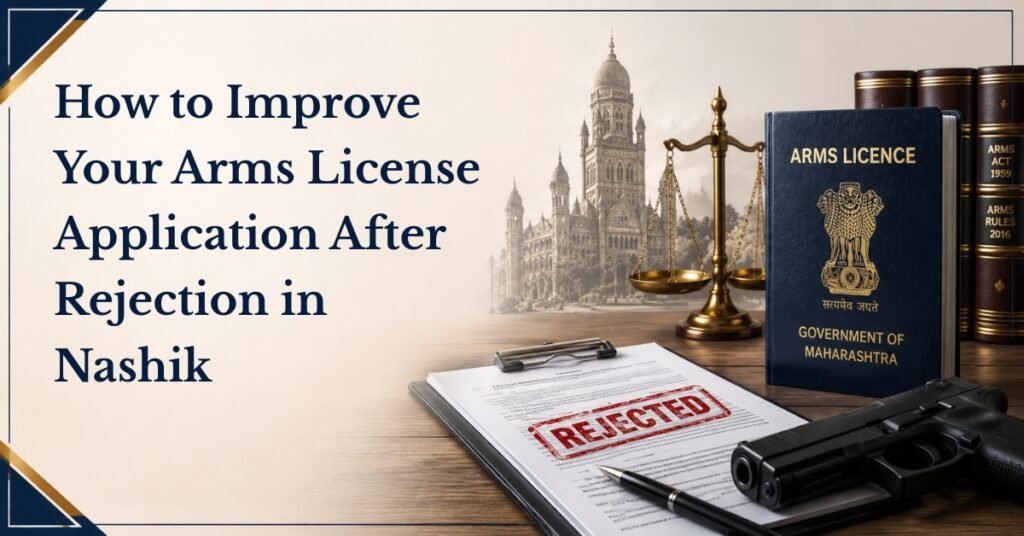
Summary: Facing an arms licence rejection in Nashik can be frustrating, but a rejection does not always mean the process ends there. Understanding the reason for refusal, correcting documentation gaps, and choosing the right appeal or reapplication strategy can make your next step more informed. This guide explains common rejection reasons, practical solutions, essential documents and mistakes to avoid before submitting your application again.
Getting a rejection letter after months of waiting for your arms licence is frustrating but it is rarely the end of the road. An arms licence rejection in Nashik usually points to a specific, fixable gap in your application rather than a permanent “no.” Licensing authorities under the Arms Act, 1959 and the Arms Rules, 2016 are required to record reasons for refusal, which means every rejection order actually contains the roadmap for what to fix next.
This guide walks you through why arms licence applications get turned down in Nashik, how to read your rejection order correctly, what a stronger fresh application or representation looks like, and when it makes sense to bring in professional help. The goal isn’t to promise you an approval no one honestly can but to help you present the strongest, most complete case possible.
Table of Contents
ToggleCommon Arms Licence Rejection Reasons in Nashik
There is no single reason why an arms licence application is rejected in Nashik. The decision may depend on the applicant’s circumstances, stated purpose, police verification, documentation and the licensing authority’s assessment.
1. Insufficient Evidence of Genuine Need
A common issue is failing to provide sufficient evidence supporting the genuine need for an arms licence. Simply stating that a firearm is required “for safety” may not adequately explain the applicant’s circumstances. Depending on the case, relevant evidence may include documented threats, security concerns, business or professional circumstances, property-related concerns or sports-shooting activities.
2. Negative or Unsatisfactory Police Verification
Police verification is an important part of the arms licensing process, and adverse findings may affect the outcome of an application. Issues can arise from discrepancies, adverse records or concerns identified during verification.If rejection is linked to the police report, submitting additional general documents may not be enough. The specific concern should first be identified and addressed with accurate, verifiable information.
3. Incomplete or Inconsistent Information
Differences between the application form, identity documents, address proof, income-tax records, business documents or other submitted information can create doubts about the accuracy of an application. Before reapplying, carefully compare all documents and ensure that names, addresses, dates, occupation details and other important information are accurate and consistent.
4. Weak Supporting Documentation
Submitting documents does not automatically strengthen an application if they do not directly support the stated purpose or circumstances. Supporting evidence should clearly establish the connection between the applicant’s situation and the reason for seeking an arms licence. For example, applicants citing business or professional security concerns should provide genuine documents that substantiate those circumstances rather than unrelated paperwork.
5. Failure to Address Previous Rejection Grounds
Simply submitting the same application again without correcting the reason for the previous rejection can result in another adverse decision. Applicants should first understand the specific deficiency identified by the licensing authority. A stronger application focuses on resolving the previous concerns with accurate information, relevant evidence, and complete documentation rather than merely adding more paperwork.
What to Do After an Arms Licence Application Is Rejected
If your arms licence application is rejected, do not immediately submit the same application again. First, understand the reason for rejection and systematically address any deficiencies before deciding whether to appeal or reapply.
Step 1: Obtain and Review the Rejection Order
Get the official written rejection order and carefully check the stated reasons, issuing authority, police verification findings and any information about your appeal rights. Your next action should be based on the reasons recorded in the order.
Step 2: Identify the Exact Reason for Rejection
Determine whether the problem relates to missing documents, incorrect information, inconsistent records, insufficient evidence of need or another substantive concern. Identifying the exact deficiency helps you choose the appropriate corrective action.
Step 3: Review the Police Verification
If police verification contributed to the rejection, identify the specific concern or discrepancy mentioned in the report. Where there is a factual error, prepare genuine and verifiable documents that clarify the issue.
Step 4: Check Whether an Appeal Is Appropriate
Depending on the circumstances, you may have the option to challenge the rejection through the applicable appeal process rather than submitting a fresh application. Under the Arms Rules, 2016, the general appeal period is 30 days from the date of issue of the order, so act promptly.
Step 5: Strengthen Your Supporting Evidence
Collect relevant and genuine documents that directly address the reason for rejection, such as updated identity, address, financial, occupation, fitness or security-related records where applicable. Avoid submitting unnecessary documents that do not support your stated circumstances.
Step 6: Check Every Detail for Consistency
Before making an appeal or fresh application, compare names, addresses, dates, occupation details and other information across all documents. Correcting inconsistencies beforehand can help avoid further questions or deficiencies.
Step 7: Seek Professional Guidance When Necessary
If the rejection involves an adverse police report, complex documentation, repeated refusal or an appeal, professional guidance may help you understand the appropriate procedural route. Any assistance should focus on accurate documentation and lawful representation, without promising approval.
How to Reapply for Arms Licence in Nashik: A Practical Framework
If you’re preparing a fresh application, treat it as a new, stronger case rather than a resubmission of the old one.
Rebuild Your Justification Around Facts, Not Statements
Instead of asserting a need, demonstrate it. If your ground is personal safety, attach any threat-related evidence, police complaints, or incident reports. If it’s for agricultural protection, include land ownership documents and, where relevant, a report on crop or livestock damage from wild animals. For sports shooting, include your shooting club membership, training records, and competition participation.
Address the Specific Rejection Ground Head-On
Don’t submit a generic reapplication. If police verification flagged a closed case, attach the final court order or closure report (charge-sheet dropped/discharge/acquittal, as applicable) to show it’s resolved. If the issue was an address mismatch, submit updated and consistent proof across all documents.
Get Updated, Consistent Documentation
Documents older than the validity window typically expected by the licensing authority (such as address proof or medical certificates) should be renewed rather than reused.
Strengthen the Character and Antecedent Profile
A character certificate from a Gazetted Officer, a letter from your employer (for salaried applicants), or community standing documents can support your case, especially where the earlier rejection touched on antecedents.
Submit Through the Correct Channel
In Nashik, arms licence applications are processed through the National Database of Arms Licenses (NDAL-AMS) online portal, routed to the jurisdictional licensing authority (District Magistrate/Collector for rural districts, Commissioner of Police for areas under Police Commissionerates such as Nashik, Pune, Nagpur, and others). Ensure your fresh application is filed with the correct authority based on your current residential jurisdiction.
Document Checklist for a Stronger Application
Use this as a starting checklist and adapt it to your specific rejection ground:
- [ ] Certified copy of the original rejection order
- [ ] Duly filled Form A-1 (application form) with no blank or ambiguous fields
- [ ] Valid identity proof (Aadhaar, PAN, passport) with consistent name spelling
- [ ] Current address proof matching across all submitted documents
- [ ] Recent medical fitness certificate from a registered medical practitioner (physical and mental fitness, eyesight)
- [ ] Character certificate from a Gazetted Officer or equivalent authority
- [ ] Documented justification/genuine need evidence (threat records, land documents, club membership, competition records, as applicable)
- [ ] Police clearance-related documents FIR closure report, discharge order, or acquittal order, if a past case was cited
- [ ] Passport-size photographs meeting current specifications
- [ ] Proof of residency duration in the district, if relevant
- [ ] Income/occupation proof, where the licensing authority requires it
- [ ] Affidavit(s) as prescribed under the Arms Rules, 2016
- [ ] Any prior correspondence or acknowledgment from the licensing authority
Keep both digital and physical copies, and maintain a dated file of everything you submit this record becomes valuable if you need to escalate later.
Common Mistakes Applicants Make After a Rejection
Avoiding the below mistakes matters just as much as strengthening your paperwork. Before submitting a fresh application, it is also useful to understand the common mistakes that delay gun licence approval in Nashik so you can avoid repeating issues that may cause further delays or complications.
Reapplying Without Changing Anything
Resubmitting the same application with the same weak justification almost guarantees the same outcome. Every fresh application should visibly address the specific ground cited in the rejection order.
Ignoring the Appeal Timeline
Waiting too long to decide between reapplication and appeal can mean losing the option to formally challenge the order under Section 18. Check the limitation period stated in your rejection order as soon as you receive it.
Submitting Inconsistent Documents
Even small mismatches a different spelling of your name, an old address on one document and a new one on another can trigger fresh scrutiny or delay.
Overstating or Exaggerating the Threat Perception
Claims that can’t be backed by evidence often do more harm than good. Authorities and appellate bodies tend to respond better to specific, verifiable facts than to dramatic language.
Not Following Up on Police Verification Status
Police verification delays or lost paperwork are common. Proactively following up with the verifying police station can prevent your fresh application from stalling for the same reason as before.
Treating “Public Safety” Refusals as Unchallengeable
Courts have repeatedly held that public peace or safety cannot be cited as a ground for refusal without specific, case-relevant reasoning. If your rejection order uses this language without particulars, it’s worth having the order reviewed rather than assuming nothing can be done.
Skipping Professional Review for Complex Cases
Straightforward documentation gaps can often be fixed on your own. But where a rejection involves a criminal case history, a public safety finding, or an unclear legal basis, a self-prepared reapplication may repeat the same errors without you realising it.
Why Hiring a Gun Licence Consultant Can Help
Hiring a gun licence consultant in Nashik can make the process easier when your application involves rejection, documentation gaps or procedural complications. Professional guidance can help you prepare a more accurate and well-supported application.
- Document Preparation & Review: Ensure your application forms, supporting documents and evidence are properly organised, complete and consistent.
- Identify Rejection Issues: Understand the specific reason for rejection and determine what needs to be corrected before submitting an appeal or fresh application.
- Procedural Guidance: Get assistance in understanding whether an appeal, representation or fresh application may be the appropriate next step for your circumstances.
- Avoid Repeated Mistakes: An experienced consultant can review your application before submission and identify potential gaps or inconsistencies that could otherwise cause further delays.
Professional assistance can improve the quality and completeness of your application, but no consultant can guarantee approval. The final decision always rests with the competent licensing authority.
Turn Your Arms License Rejection Into a Better-Prepared Application
Facing an arms license rejection in Nashik does not necessarily mean the process ends there. Understanding the rejection reason, correcting deficiencies, preparing genuine supporting documents and choosing the appropriate appeal or reapplication route can help you avoid repeating the same mistakes.
For applicants who need professional support, India Arms License can assist with application review, documentation and procedural guidance based on individual circumstances. Seeking arm and gun license assistance in Nashik can help ensure your application is properly prepared and supported, although approval can never be guaranteed.
Contact today to get your arms licence application reviewed and take the right next step after rejection.
Frequently Asked Questions
- Can I reapply immediately after my arms license is rejected in Nashik?
Yes, in most cases you can submit a fresh application at any time. However, it’s worth addressing the specific rejection ground first; reapplying without changes rarely produces a different outcome.
- What is the time limit to appeal an arms license rejection?
Appeals under Section 18 of the Arms Act, 1959 must be filed within the limitation period specified in the rejection order or under the applicable rules. Check your order carefully, as this period is generally short and strict.
- Will a past FIR always disqualify me from getting an arms license?
Not necessarily. If the case was closed, you were discharged, or you were acquitted, submitting the relevant court or police documentation can address the concern in a fresh application or appeal.
- Does an adverse police report mean automatic rejection?
An adverse report is a significant factor, but not always the sole or final word; much depends on the specifics of the report and how it’s addressed in your response. Authorities are also expected to give applicants an opportunity to respond in many cases.
- Should I hire a consultant or lawyer for a rejected arms license application?
It depends on the complexity of your case. Simple documentation issues can often be fixed independently, but cases involving criminal history, vague public safety grounds, or a previous unsuccessful appeal often benefit from professional review.