
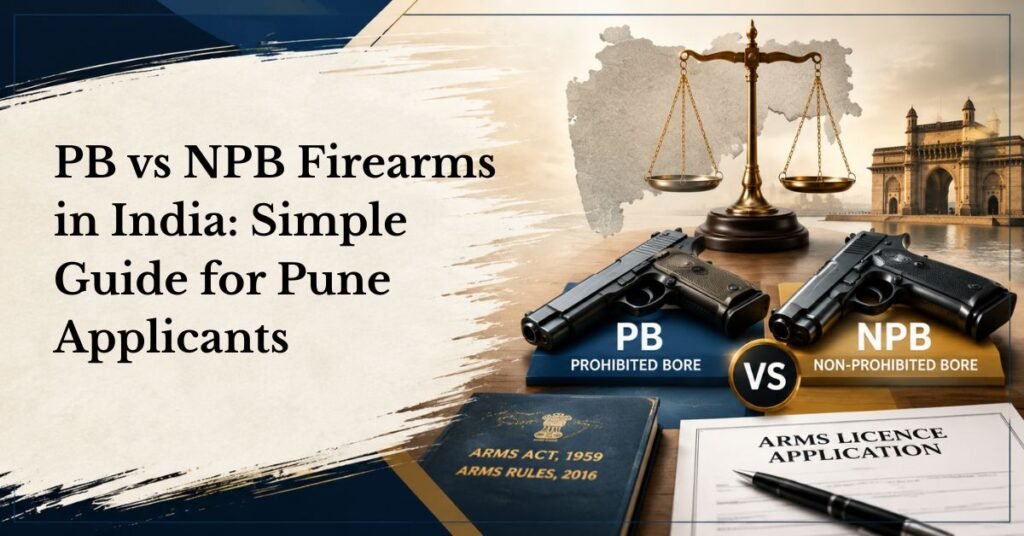
Summary: PB (Prohibited Bore) and NPB (Non-Prohibited Bore) are the two legal classifications that shape every arms license application in India, yet most applicants confuse them, assuming one is simply “stronger” than the other. Understanding the real difference isn’t just academic: it determines which category you can realistically apply for, how your application is evaluated, and whether costly delays or rejections can be avoided. This guide breaks down both categories in simple language so that the applicants can approach the process with clarity, accuracy, and realistic expectations.
Many first-time applicants in Pune believe that choosing a “PB” firearm on their application will make their license “stronger” or give them better personal security. Others don’t fully understand the difference between PB and NPB at all and end up selecting the wrong category on their arms license application without realizing it.
This confusion is more common than most people expect, and it isn’t a small detail. The category you mention in your application affects how your request is understood, evaluated, and processed by the licensing authority. Applicants who misunderstand this distinction sometimes face delays, requests for clarification, or a rejection that could have been avoided with the right information from the start.cThis guide explains what PB and NPB actually mean, how they differ, and what most civilian applicants in Pune can realistically expect.
Table of Contents
ToggleWhat Does PB Mean?
PB stands for Prohibited Bore. This is a legal classification used under Indian arms law to describe a category of firearms and ammunition that fall under stricter government control.
In simple terms:
- PB firearms include weapons and ammunition types that are treated as more tightly restricted by law.
- This classification exists because of the specific technical and regulatory characteristics associated with these firearms.
- Access to this category is generally limited and is not treated as a standard or default option for civilian applicants.
- Licensing authorities apply a higher degree of scrutiny when any request touches this category.
It’s important to understand that “Prohibited Bore” does not mean these firearms are automatically unavailable to every citizen in every circumstance — but it does mean the bar for consideration is significantly higher, and approval depends on specific, well-documented circumstances rather than general preference.
Key Takeaway: PB is a restrictive classification, not a “premium” or “upgraded” firearm category. It exists to keep certain firearms under closer regulatory control.
What Does NPB Mean?
NPB stands for Non-Prohibited Bore. This classification covers firearms that fall outside the restricted PB category and are the category most commonly associated with civilian arms licenses in India.
In simple terms:
- NPB is the classification most first-time applicants and typical civilian license holders encounter.
- It includes firearm types that are legally accessible to eligible civilians who meet the licensing criteria.
- Most licenses issued for personal safety, sport, or professional necessity in Pune fall within this category.
- Eligibility still depends on documented need, a clean legal record, and approval through the standard verification process. NPB does not mean automatic approval.
Key Takeaway: NPB is the standard classification most Pune civilian applicants work with. It is the realistic starting point for the large majority of lawful applications.
PB vs NPB Firearms: Complete Comparison Table
Aspect | PB (Prohibited Bore) | NPB (Non-Prohibited Bore) |
Meaning | Restricted classification under Indian arms law | Standard classification available to eligible civilians |
Civilian Availability | Very limited; considered only in specific, well-justified circumstances | Common pathway for most lawful civilian applicants |
General Eligibility | Requires strong, specific, documented justification | Requires standard eligibility, documentation, and genuine need |
Licensing Considerations | Higher scrutiny, longer evaluation, stricter conditions | Standard evaluation process under the normal licensing procedure |
Typical Applicants | Rare civilian cases with distinct circumstances; certain authorized categories | Business owners, professionals, individuals with documented personal security needs |
Regulatory Oversight | Closer and more restrictive oversight | Standard regulatory oversight applicable to civilian licenses |
Common Misconception | Seen as “more powerful” or “premium,” leading applicants to assume it’s simply a better choice | Sometimes viewed as a lesser option, when in fact it is the appropriate and lawful category for most applicants |
Which Category Can Most Pune Applicants Apply For?
For the overwhelming majority of civilian applicants in Pune business owners, jewelers, industrialists, and professionals with genuine, documented security considerations, the NPB category is the realistic and appropriate pathway.
A few points worth understanding clearly:
- Licensing decisions are made by the competent authority based on the specifics of each application, not on which category “sounds” stronger.
- Genuine need must be demonstrated with proper supporting documentation a general sense of insecurity is not, on its own, sufficient justification.
- Selecting a category simply because it seems more impressive can actually work against an applicant, since it may appear disconnected from the stated purpose.
- No consultancy, agent, or guide can guarantee approval. The final decision always rests with the licensing authority.
If you believe your circumstances are unusual or involve heightened risk, that assessment should be based on documented facts and discussed with a professional who understands the application process not assumed from general firearm terminology.
Common Myths About PB and NPB
Myth 1: “PB firearms are easier to obtain.”
This is incorrect. PB is a more restricted category, which typically means more scrutiny and a narrower set of circumstances under which it is even considered not an easier process.
Myth 2: “Choosing PB increases approval chances.”
Selecting PB does not improve your odds. If anything, applying for a category that doesn’t align with your documented need can raise questions and slow down the review process.
Myth 3: “Every firearm license allows any weapon.”
A license is specific to the category and, often, the type of firearm approved. It does not function as a general permission to acquire any firearm of your choice.
Myth 4: “Security concerns automatically qualify someone.”
Feeling unsafe is a real and valid concern, but licensing decisions are based on documented, verifiable circumstances such as your profession, past incidents, or specific threat assessment not general apprehension alone.
Common Mistakes That Delay or Complicate Applications
Applicants, especially first-timers, often run into avoidable issues. Some of the most frequent ones include:
- Selecting the wrong firearm category without understanding what it legally represents.
- Misjudging eligibility, assuming that owning a business or having wealth alone justifies a license.
- Filing without proper guidance leads to gaps in the application that raise avoidable questions.
- Relying on unverified online information, including outdated forums or informal advice from acquaintances.
- Using incorrect or inconsistent terminology across the application and supporting documents.
- Submitting incomplete documentation, such as missing proof of need, address verification, or identity records.
None of these mistakes are unusual, and most are entirely preventable with accurate information and careful preparation before submission. Read our guide on Common Mistakes That Delay Gun License Approval in Pune.
How to Decide Which Category Is Relevant
Before applying, it helps to work through a simple, honest checklist:
- What is my lawful purpose? (Personal security, professional necessity, sport, etc.)
- Do I meet the general eligibility criteria set out under Indian arms law and Maharashtra’s licensing procedure?
- Is my documentation ready — identity proof, address proof, character verification, and any evidence supporting genuine need?
- Have I clearly and honestly represented my need, rather than choosing a category based on assumptions about which one is “stronger”?
- Would professional guidance help me understand which category and supporting documentation are appropriate for my specific situation?
If you’re unsure about any of these points, it is worth clarifying them before submission rather than after — since corrections after filing can extend the overall timeline.
Conclusion
Understanding the difference between PB and NPB firearms is one of the simplest ways Pune applicants can avoid confusion, reduce avoidable mistakes, and approach the arms licence application process with realistic expectations. Neither category is inherently “better” each serves a different regulatory purpose, and the appropriate category depends on your genuine, lawful need and eligibility, as determined by the competent licensing authority.
If you’re looking for reliable arm and gun license assistance in Pune, India Arms License can provide professional guidance to help you understand firearm categories, prepare accurate documentation, and navigate the application process with greater clarity and confidence.
Not sure which firearm category applies to you? Get expert clarity before you apply. Consult India Arms License today.
This article is intended for general educational purposes only. Firearm classifications, eligibility criteria, and licensing procedures are governed by applicable Indian law and are subject to change. Readers should verify current requirements directly with the relevant licensing authorities before making any application-related decisions.
Frequently Asked Questions
Is PB better than NPB?
No. PB and NPB are different regulatory classifications, not a “better vs. worse” comparison. PB is more restricted, and NPB is the standard category for most civilian applicants.
Can civilians own PB firearms?
In very limited, specific circumstances, and only after meeting a significantly higher standard of scrutiny and justification. It is not a typical or default pathway for civilian applicants.
What is the difference between PB and NPB?
The core difference lies in the level of legal restriction and regulatory oversight. PB firearms are more tightly controlled, while NPB firearms are accessible to eligible civilians through the standard licensing process.
Which firearm category is commonly associated with civilian licenses?
NPB is the category most civilian licenses in Maharashtra fall under.
Can I change the firearm category later?
Category-related changes are handled through the appropriate application or amendment process with the licensing authority. It is not a simple after-the-fact adjustment, so it’s best to select the correct category from the outset.