
Arms Licence Renewal in Thane: 2026 Step-by-Step Process, Documents & Requirements
Quick Summary: Renewing an arms licence in Maharashtra requires timely application, correct documentation and compliance with the applicable licensing procedure. This 2026 guide covers the arms licence renewal process, eligibility, required documents, NDAL-ALIS online procedure, verification, important timelines and expired-licence cases. It also explains common mistakes and when professional assistance may help you navigate the process more efficiently and accurately. Renewing an arms licence in Maharashtra is an important legal and administrative process that requires timely action, accurate documentation, and compliance with the applicable rules. From checking your licence expiry date to selecting the correct renewal service and completing required verification or inspection, each step matters when maintaining a valid licence. With online services such as NDAL-ALIS available for specified applications, the renewal process can appear straightforward but documentation requirements and authority procedures can vary depending on the licence and individual circumstances. This guide explains the 2026 arms licence renewal process, required documents, important timelines, online application procedure, common mistakes and when seeking professional guidance may be helpful. What Is Arms Licence Renewal in Maharashtra? Arms licence renewal is the process through which an existing firearm licence is renewed by the competent licensing authority after its validity period approaches expiry or, subject to applicable rules, after expiry. Renewal is different from applying for a completely new arms licence. A renewal application concerns an existing licence and its continuing validity. The authority may examine the existing licence, firearm details, compliance and other relevant information before deciding the renewal application.The Government of India’s NDAL-ALIS portal specifically provides renewal services for specified licence categories, including renewal applications for licences in Forms II, III and IV. When Should You Apply for Arms Licence Renewal in Maharashtra? You should normally begin the renewal process at least 60 days before the licence expires. Rule 24 of the Arms Rules, 2016 specifies that an application for renewal shall be filed in the prescribed form at least 60 days before expiry. Recommended renewal timeline Stage What to do More than 60 days before expiry Check licence, firearm and personal details At least 60 days before expiry File the renewal application After submission Complete verification/inspection requirements, if applicable Before expiry Follow up on pending requirements and authority instructions If already expired Contact the concerned licensing authority immediately and follow the applicable late-renewal procedure Do not assume that an application submitted after expiry will automatically be accepted or renewed. Maharashtra Police publishes separate guidance for licences that have already expired. Arms Licence Renewal Documents: What Do You Need? The exact arms licence renewal documents can depend on the licence category, authority and circumstances. Therefore, applicants should verify the document checklist shown for their particular service before submission. Commonly relevant documents and information may include: Existing/original arms licence Renewal application/form Recent photographs, where required Identity proof Address/residence proof Firearm details Weapon-related documents or records Applicable supporting documents requested by the licensing authority Fee/payment details Explanation and supporting evidence if the application is delayed Additional documents where there has been a change in address, personal details or other licence particulars Maharashtra Police’s published renewal form specifically captures the licence/file number, licence holder’s name and address, firearm details such as make, bore and manufacturer’s number, date of birth, profession and income, justification for renewal, licence expiry details, renewal period sought and an explanation for delay where the application is submitted after expiry. Arms Licence Renewal Documents Checklist Before submission, check: Existing arms licence Correct renewal application Current identity details Current address proof Recent photographs, if requested Correct firearm make/bore/serial or manufacturer’s details Applicable supporting documents Renewal fee/payment information Delay explanation and supporting documents, if applicable Any additional documents specifically requested by the licensing authority Practical tip: Do not rely on an old document checklist without checking the current requirements for your licence and authority. Step-by-Step Arms Licence Renewal Process in Maharashtra Step 1: Check Your Existing Licence Before starting the arms licence renewal process, carefully verify: Licence number UIN, where applicable Licence holder’s name Date of birth Current address Firearm details Licence form/category Area validity Expiry date Ammunition entitlement, where applicable If any information is outdated, determine whether a separate change/correction service is required. Step 2: Check the Renewal Deadline The central rule requires the renewal application to be filed at least 60 days before expiry. For example, if your licence expires on 31 December, you should not wait until the final few days of December to begin the process. Early preparation gives you time to identify missing documents or resolve discrepancies. Step 3: Identify the Correct Renewal Service NDAL-ALIS lists different services and application forms under the Arms Rules, 2016. Its current services include: Form A-3 for renewal of arms licences in Forms II, III and IV Form A-3 for specified sports applications Form A-4 for renewal of arms licences in Forms II, III and IV Other services relating to changes, endorsements and licence administration The correct service depends on the licence and circumstances, so applicants should select the applicable service rather than assuming that every licence uses the same form. Step 4: Prepare the Arms Licence Renewal Documents Scan or prepare the documents required for the relevant application. Make sure: Names are consistent across documents. Address information is current. Firearm details match the existing licence. Photographs meet the specified requirements. Supporting documents are clear and readable. Any explanation for delay is supported with appropriate evidence. Incorrect or inconsistent information can result in additional scrutiny or requests for clarification. Step 5: Submit Through the Applicable Channel Where the relevant service is available, NDAL-ALIS provides an online route for arms licence-related applications. The Government of India’s NDAL-ALIS portal identifies itself as the Arms Licence Online system under the Ministry of Home Affairs and lists renewal services among its available services. However, an online submission should not automatically be interpreted as meaning that every part of the renewal process is completed online. Depending on the application, the licensing authority may still require physical inspection, verification, original documents or other procedural steps. Step 6:
How Business Owners Can Increase Their Chances of Arms License Approval in Nagpur
Summary : Running a business in Nagpur can sometimes mean facing real security concerns, especially when you handle cash, valuable stock, or operate in locations where safety risks are higher than usual. This blog includes a summary of the arms license approval process, the documents business owners should keep ready, how police verification works, common reasons applications get delayed or rejected, and practical steps that can improve the chances of approval. An arms license is never automatic, though. Approval depends on a genuine need, proper documents, police verification, and the licensing authority’s satisfaction after checking the application carefully. For business owners, the biggest mistake is assuming that a strong business profile alone is enough to get an arms license. In reality, the licensing process is formal, document-heavy, and closely tied to public safety rules under the Arms Act and Arms Rules. Applicants must show a lawful reason, complete the prescribed form, pass verification, and be ready for an interview before the licensing authority makes a final decision. Why Do Business Owners Need A Gun For Personal And Business Security? Handle High Cash Transactions Businesses that regularly deal with large cash collections, such as retail stores, fuel stations, or financial service providers, may face an increased risk of theft or robbery. In certain situations, business owners may apply for an arms license to enhance their personal security while carrying out these responsibilities. Protect High-Value Goods And Inventory Businesses involved in jewellery, precious metals, luxury products, electronics, or other valuable inventory often face higher security risks. A legally licensed firearm may be considered by some business owners as part of their overall security preparedness when genuine threats exist. Respond To Documented Security Threats Business owners who have received repeated threats, experienced attempted robberies, or reported criminal incidents may have legitimate reasons to seek additional protection. Supporting evidence such as police complaints or incident records can strengthen an arms license application. Operate In Remote Or High-Risk Locations Businesses located in isolated industrial areas, rural regions, or places with limited security infrastructure may face additional safety challenges. In such circumstances, some business owners may apply for an arms license after demonstrating a genuine need for personal protection. Protect Themselves During Business Travel Many business owners frequently travel with important documents, cash, or valuable products. Those who regularly visit unfamiliar or high-risk locations may consider applying for an arms license to improve personal safety while conducting legitimate business activities. Strengthen Overall Business Security Planning A firearm should never replace professional security measures such as CCTV surveillance, alarm systems, trained security personnel, and access control. However, for business owners with a genuine security need and a valid arms license, it may form one part of a broader security strategy that prioritizes legal compliance and responsible firearm ownership. Who Is Eligible To Apply For An Arms License In Nagpur? Before applying for an arms license, business owners should understand whether they meet the eligibility requirements prescribed under the Arms Act and the applicable rules. Simply owning a business does not guarantee approval. Minimum Age Requirement The applicant must meet the minimum age requirement prescribed under the law. The licensing authority verifies the applicant’s age through valid documents such as a birth certificate, Aadhaar card, passport, or other government-issued identity proof. Indian Citizenship Only eligible Indian citizens can apply for an arms license in Nagpur. Applicants must submit valid identity and address proof to establish their citizenship and residence during the application process. Mental And Physical Fitness Applicants should be mentally and physically fit to possess and safely handle a firearm. Depending on the type of application, authorities may require a medical certificate to confirm that the applicant does not have any condition that could affect the responsible use of a firearm. Clean Criminal Background A clean legal record is one of the most important factors considered during verification. The police conduct background checks to determine whether the applicant has been involved in criminal activities, pending cases, or any history that may make firearm ownership unsuitable. Genuine Security Threat Or Valid Reason An arms license is generally issued only when the applicant can demonstrate a genuine and lawful reason for requiring one. For business owners, this may include handling large amounts of cash, transporting valuable goods, managing high-value inventory, operating in isolated areas, or facing documented security threats. The reason should be supported with relevant evidence wherever possible. Business-Related Security Concerns The licensing authority may consider the nature of the applicant’s business while assessing the application. Businesses dealing with jewellery, precious metals, financial transactions, cash collection, valuable inventory, or remote operations may have legitimate security concerns that require additional protection. Successful Police Verification Every application undergoes police verification before approval. During this stage, officials verify the applicant’s identity, residential address, business details, character, and the information provided in the application. Cooperating fully with the verification process can help prevent unnecessary delays. Approval By The Licensing Authority Even after completing all formalities, the final decision rests with the District Magistrate or the designated licensing authority. They evaluate the applicant’s eligibility, police verification report, supporting documents, and overall circumstances before granting or rejecting the arms license application. Business owners who satisfy these eligibility requirements and submit a complete, truthful, and well-supported application generally have a better chance of moving smoothly through the licensing process. What Documents Do Business Owners Need To Apply For An Arms License In Nagpur? A strong application starts with a complete document set. The key documents may include: Form A-1 Safe-keeping place declaration (S-2) or safe-storage undertaking Medical certificate (S-3) Affidavit stating that you have not been arrested or convicted Identity proof Age proof Residence proof Income documents Firearm handling training certificate Ration card or election card Income tax returns Character certificates Physical fitness certificate Educational proof Documents supporting the need for the licence Business registration papers GST details Tax records Shop or office ownership or lease papers Threat-related records Submitting complete and accurate documents can increase your chances of arms license approval during the
Who Should Not Apply For An Arms License In Nagpur?
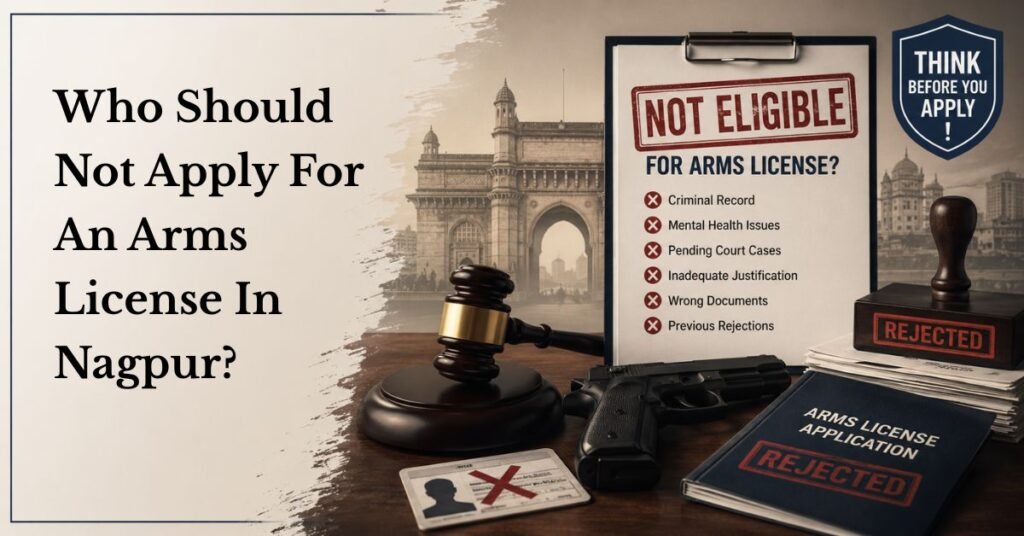
Summary: Applying for an arms license in Nagpur without understanding the legal eligibility criteria can lead to rejection, financial loss, and unnecessary delays. This guide explains who should not apply, the most common reasons applications are refused, and the practical steps you can take to improve your chances before submitting your application. Whether you’re applying for self-defense, sports shooting, or another valid reason, this article will help you make an informed decision before starting the licensing process. Every year, thousands of applicants across Maharashtra, from Mumbai and Pune to Nashik, Nagpur, and smaller districts, submit arms license applications only to face rejection months later. The fees are non-refundable in most cases, the paperwork is extensive, and a rejection on your record can make future applications harder. Before you invest your time, money, and hope into this process, it’s worth asking an uncomfortable but important question: should you even be applying right now? This guide is not meant to discourage genuinely eligible citizens from exercising their legal right to self-defense or sport shooting. Instead, it’s designed to help you honestly evaluate your situation against the Arms Act, 1959, and the Arms Rules, 2016, so you don’t waste effort on an application that’s likely to be turned down, and so you know exactly what to fix before trying again. Eligibility Overview: What the Law Actually Requires Under the Arms Act, 1959 and the Arms Rules, 2016, a licensing authority typically the District Magistrate or the Commissioner of Police in Nagpur’s jurisdictions, evaluates every application on a combination of factors: citizenship, age, criminal history, mental and physical fitness, genuine need, and local law-and-order considerations. There is no automatic entitlement; even a fully “eligible” applicant can be refused if the authority isn’t satisfied that possession of a firearm is safe or necessary in their specific case. That discretionary element is exactly why so many well-intentioned applicants get rejected. They meet the basic checklist but overlook the practical and contextual factors that actually decide the outcome. Categories of People Likely to Be Rejected for a Gun License in Nagpur 1. Applicants With a Criminal Record or Pending Cases Anyone with a conviction, or even a pending FIR or criminal proceeding, including cases that seem minor, like a scuffle or a cheque-bounce matter, is almost certain to face rejection. Police verification in Nagpur is thorough, and local station records, court databases, and neighborhood inquiries are all cross-checked. Even cases where you were later acquitted can trigger additional scrutiny. 2. Applicants Below 21 Years of Age With limited exceptions for supervised sport-shooting categories recognized by the National Rifle Association of India, applicants must be at least 21. Minors and young adults without the relevant sporting affiliation should not apply for a standard license. 3. Applicants With Unresolved Mental Health or Chronic Health Concerns A medical fitness certificate confirming sound mental and physical health is mandatory. Individuals under treatment for psychiatric conditions, those with a history of substance dependence, or applicants who cannot pass a basic medical fitness assessment are routinely disqualified not as a punishment, but because firearm safety law prioritizes public safety above individual preference. 4. Applicants Without a Genuine, Demonstrable Need “I want a gun for protection” is not, by itself, sufficient justification. Nagpur authorities expect specific, evidence-backed reasons a documented threat perception with police complaints, participation in a recognized shooting sport, agricultural crop protection in a verified rural context, or a professional requirement. Applicants who cannot substantiate their reason with paperwork are frequently turned away. 5. Applicants With a History of Public Disturbance or Local Complaints Character verification includes informal inquiries with neighbors, local police, and community members. A history of public disputes, domestic violence complaints, noise or nuisance complaints, or a generally volatile reputation in the community can weigh heavily against an application, even without a formal conviction. 6. Non-Citizens and Certain NRIs/OCI Cardholders Only Indian citizens are eligible for a standard civilian arms license. Overseas Citizens of India (OCI) cardholders, foreign nationals, and most NRIs without specific government authorization are not eligible and should not apply through the standard civilian route. 7. Applicants Residing in Sensitive or Restricted Zones Without Extra Justification Individuals residing in designated sensitive areas, near international borders, or in localities under heightened security concern may face additional restrictions or a higher bar for approval, even if they otherwise meet the basic criteria. 8. First-Time Applicants Applying for a Prohibited Bore (PB) Weapon PB weapons are reserved almost exclusively for defense, law enforcement, or individuals under a verified, serious, and ongoing threat to life. A first-time civilian applicant requesting a PB firearm without an extraordinary threat dossier is very unlikely to succeed and should instead explore the Non-Prohibited Bore (NPB) category. For a detailed explanation, read our guide on PB vs NPB Firearms in India: Simple Guide for Nagpur Applicants before deciding which type of license to pursue. 9. Applicants With Incomplete or Inconsistent Documentation History This isn’t a “who” so much as a “how,” but it belongs here: applicants who have previously submitted inconsistent addresses, mismatched identity documents, or unexplained gaps in employment or residence history often get flagged during verification, leading to delays or outright rejection. Common Misconceptions About Arms License Eligibility “Owning property or being a taxpayer guarantees approval.” It doesn’t. Financial standing has no bearing on eligibility. “A license once denied can never be reapplied for.” Not true but reapplying without addressing the original rejection reason usually results in the same outcome. “Self-defense is always a valid reason.” Only when backed by credible, documented evidence of a specific threat. “Political or social connections speed up approval.” Licensing decisions are meant to be based strictly on legal criteria and verification outcomes, not influence. “An acquittal erases the impact of a past case.” Acquittals help, but the licensing authority may still consider the underlying conduct during character assessment. Frequent Mistakes That Lead to Rejection Applying immediately after a dispute or FIR without waiting for resolution. Submitting a vague “self-protection” justification without any supporting police complaint or
How Business Owners Can Increase Their Chances of Arms License Approval in Maharashtra
Summary : Running a business in Maharashtra can sometimes mean facing real security concerns, especially when you handle cash, valuable stock, or operate in locations where safety risks are higher than usual. This blog includes a summary of the arms license approval process, the documents business owners should keep ready, how police verification works, common reasons applications get delayed or rejected, and practical steps that can improve the chances of approval. An arms license is never automatic, though. Approval depends on a genuine need, proper documents, police verification, and the licensing authority’s satisfaction after checking the application carefully. For business owners, the biggest mistake is assuming that a strong business profile alone is enough to get an arms license. In reality, the licensing process is formal, document-heavy, and closely tied to public safety rules under the Arms Act and Arms Rules. Applicants must show a lawful reason, complete the prescribed form, pass verification, and be ready for an interview before the licensing authority makes a final decision. Why Do Business Owners Need A Gun For Personal And Business Security? Handle High Cash Transactions Businesses that regularly deal with large cash collections, such as retail stores, fuel stations, or financial service providers, may face an increased risk of theft or robbery. In certain situations, business owners may apply for an arms license to enhance their personal security while carrying out these responsibilities. Protect High-Value Goods And Inventory Businesses involved in jewellery, precious metals, luxury products, electronics, or other valuable inventory often face higher security risks. A legally licensed firearm may be considered by some business owners as part of their overall security preparedness when genuine threats exist. Respond To Documented Security Threats Business owners who have received repeated threats, experienced attempted robberies, or reported criminal incidents may have legitimate reasons to seek additional protection. Supporting evidence such as police complaints or incident records can strengthen an arms license application. Operate In Remote Or High-Risk Locations Businesses located in isolated industrial areas, rural regions, or places with limited security infrastructure may face additional safety challenges. In such circumstances, some business owners may apply for an arms license after demonstrating a genuine need for personal protection. Protect Themselves During Business Travel Many business owners frequently travel with important documents, cash, or valuable products. Those who regularly visit unfamiliar or high-risk locations may consider applying for an arms license to improve personal safety while conducting legitimate business activities. Strengthen Overall Business Security Planning A firearm should never replace professional security measures such as CCTV surveillance, alarm systems, trained security personnel, and access control. However, for business owners with a genuine security need and a valid arms license, it may form one part of a broader security strategy that prioritizes legal compliance and responsible firearm ownership. Who Is Eligible To Apply For An Arms License In Maharashtra? Before applying for an arms license, business owners should understand whether they meet the eligibility requirements prescribed under the Arms Act and the applicable rules. Simply owning a business does not guarantee approval. Minimum Age Requirement The applicant must meet the minimum age requirement prescribed under the law. The licensing authority verifies the applicant’s age through valid documents such as a birth certificate, Aadhaar card, passport, or other government-issued identity proof. Indian Citizenship Only eligible Indian citizens can apply for an arms license in Maharashtra. Applicants must submit valid identity and address proof to establish their citizenship and residence during the application process. Mental And Physical Fitness Applicants should be mentally and physically fit to possess and safely handle a firearm. Depending on the type of application, authorities may require a medical certificate to confirm that the applicant does not have any condition that could affect the responsible use of a firearm. Clean Criminal Background A clean legal record is one of the most important factors considered during verification. The police conduct background checks to determine whether the applicant has been involved in criminal activities, pending cases, or any history that may make firearm ownership unsuitable. Genuine Security Threat Or Valid Reason An arms license is generally issued only when the applicant can demonstrate a genuine and lawful reason for requiring one. For business owners, this may include handling large amounts of cash, transporting valuable goods, managing high-value inventory, operating in isolated areas, or facing documented security threats. The reason should be supported with relevant evidence wherever possible. Business-Related Security Concerns The licensing authority may consider the nature of the applicant’s business while assessing the application. Businesses dealing with jewellery, precious metals, financial transactions, cash collection, valuable inventory, or remote operations may have legitimate security concerns that require additional protection. Successful Police Verification Every application undergoes police verification before approval. During this stage, officials verify the applicant’s identity, residential address, business details, character, and the information provided in the application. Cooperating fully with the verification process can help prevent unnecessary delays. Approval By The Licensing Authority Even after completing all formalities, the final decision rests with the District Magistrate or the designated licensing authority. They evaluate the applicant’s eligibility, police verification report, supporting documents, and overall circumstances before granting or rejecting the arms license application. Business owners who satisfy these eligibility requirements and submit a complete, truthful, and well-supported application generally have a better chance of moving smoothly through the licensing process. What Documents Do Business Owners Need To Apply For An Arms License In Maharashtra? A strong application starts with a complete document set. The key documents may include: Form A-1 Safe-keeping place declaration (S-2) or safe-storage undertaking Medical certificate (S-3) Affidavit stating that you have not been arrested or convicted Identity proof Age proof Residence proof Income documents Firearm handling training certificate Ration card or election card Income tax returns Character certificates Physical fitness certificate Educational proof Documents supporting the need for the licence Business registration papers GST details Tax records Shop or office ownership or lease papers Threat-related records Submitting complete and accurate documents can increase your chances of arms license approval during the
PB vs NPB Firearms in India: Simple Guide for Nashik Applicants
Summary: PB (Prohibited Bore) and NPB (Non-Prohibited Bore) are the two legal classifications that shape every arms license application in India, yet most applicants confuse them, assuming one is simply “stronger” than the other. Understanding the real difference isn’t just academic: it determines which category you can realistically apply for, how your application is evaluated, and whether costly delays or rejections can be avoided. This guide breaks down both categories in simple language so that the applicants can approach the process with clarity, accuracy, and realistic expectations. Many first-time applicants in Nashik believe that choosing a “PB” firearm on their application will make their license “stronger” or give them better personal security. Others don’t fully understand the difference between PB and NPB at all and end up selecting the wrong category on their arms license application without realizing it. This confusion is more common than most people expect, and it isn’t a small detail. The category you mention in your application affects how your request is understood, evaluated, and processed by the licensing authority. Applicants who misunderstand this distinction sometimes face delays, requests for clarification, or a rejection that could have been avoided with the right information from the start.cThis guide explains what PB and NPB actually mean, how they differ, and what most civilian applicants in Nashik can realistically expect. What Does PB Mean? PB stands for Prohibited Bore. This is a legal classification used under Indian arms law to describe a category of firearms and ammunition that fall under stricter government control. In simple terms: PB firearms include weapons and ammunition types that are treated as more tightly restricted by law. This classification exists because of the specific technical and regulatory characteristics associated with these firearms. Access to this category is generally limited and is not treated as a standard or default option for civilian applicants. Licensing authorities apply a higher degree of scrutiny when any request touches this category. It’s important to understand that “Prohibited Bore” does not mean these firearms are automatically unavailable to every citizen in every circumstance — but it does mean the bar for consideration is significantly higher, and approval depends on specific, well-documented circumstances rather than general preference. Key Takeaway: PB is a restrictive classification, not a “premium” or “upgraded” firearm category. It exists to keep certain firearms under closer regulatory control. What Does NPB Mean? NPB stands for Non-Prohibited Bore. This classification covers firearms that fall outside the restricted PB category and are the category most commonly associated with civilian arms licenses in India. In simple terms: NPB is the classification most first-time applicants and typical civilian license holders encounter. It includes firearm types that are legally accessible to eligible civilians who meet the licensing criteria. Most licenses issued for personal safety, sport, or professional necessity in Nashik fall within this category. Eligibility still depends on documented need, a clean legal record, and approval through the standard verification process. NPB does not mean automatic approval. Key Takeaway: NPB is the standard classification most Nashik civilian applicants work with. It is the realistic starting point for the large majority of lawful applications. PB vs NPB Firearms: Complete Comparison Table Aspect PB (Prohibited Bore) NPB (Non-Prohibited Bore) Meaning Restricted classification under Indian arms law Standard classification available to eligible civilians Civilian Availability Very limited; considered only in specific, well-justified circumstances Common pathway for most lawful civilian applicants General Eligibility Requires strong, specific, documented justification Requires standard eligibility, documentation, and genuine need Licensing Considerations Higher scrutiny, longer evaluation, stricter conditions Standard evaluation process under the normal licensing procedure Typical Applicants Rare civilian cases with distinct circumstances; certain authorized categories Business owners, professionals, individuals with documented personal security needs Regulatory Oversight Closer and more restrictive oversight Standard regulatory oversight applicable to civilian licenses Common Misconception Seen as “more powerful” or “premium,” leading applicants to assume it’s simply a better choice Sometimes viewed as a lesser option, when in fact it is the appropriate and lawful category for most applicants Which Category Can Most Nashik Applicants Apply For? For the overwhelming majority of civilian applicants in Nashik business owners, jewelers, industrialists, and professionals with genuine, documented security considerations, the NPB category is the realistic and appropriate pathway. A few points worth understanding clearly: Licensing decisions are made by the competent authority based on the specifics of each application, not on which category “sounds” stronger. Genuine need must be demonstrated with proper supporting documentation a general sense of insecurity is not, on its own, sufficient justification. Selecting a category simply because it seems more impressive can actually work against an applicant, since it may appear disconnected from the stated purpose. No consultancy, agent, or guide can guarantee approval. The final decision always rests with the licensing authority. If you believe your circumstances are unusual or involve heightened risk, that assessment should be based on documented facts and discussed with a professional who understands the application process not assumed from general firearm terminology. Common Myths About PB and NPB Myth 1: “PB firearms are easier to obtain.” This is incorrect. PB is a more restricted category, which typically means more scrutiny and a narrower set of circumstances under which it is even considered not an easier process. Myth 2: “Choosing PB increases approval chances.” Selecting PB does not improve your odds. If anything, applying for a category that doesn’t align with your documented need can raise questions and slow down the review process. Myth 3: “Every firearm license allows any weapon.” A license is specific to the category and, often, the type of firearm approved. It does not function as a general permission to acquire any firearm of your choice. Myth 4: “Security concerns automatically qualify someone.” Feeling unsafe is a real and valid concern, but licensing decisions are based on documented, verifiable circumstances such as your profession, past incidents, or specific threat assessment not general apprehension alone. Common Mistakes That Delay or Complicate Applications Applicants, especially first-timers, often run into avoidable issues. Some
How Business Owners Can Increase Their Chances of Arms License Approval in Mumbai
Summary : Running a business in Mumbai can sometimes mean facing real security concerns, especially when you handle cash, valuable stock, or operate in locations where safety risks are higher than usual. This blog includes a summary of the arms license approval process, the documents business owners should keep ready, how police verification works, common reasons applications get delayed or rejected, and practical steps that can improve the chances of approval. An arms license is never automatic, though. Approval depends on a genuine need, proper documents, police verification, and the licensing authority’s satisfaction after checking the application carefully. For business owners, the biggest mistake is assuming that a strong business profile alone is enough to get an arms license. In reality, the licensing process is formal, document-heavy, and closely tied to public safety rules under the Arms Act and Arms Rules. Applicants must show a lawful reason, complete the prescribed form, pass verification, and be ready for an interview before the licensing authority makes a final decision. Why Do Business Owners Need A Gun For Personal And Business Security? Handle High Cash Transactions Businesses that regularly deal with large cash collections, such as retail stores, fuel stations, or financial service providers, may face an increased risk of theft or robbery. In certain situations, business owners may apply for an arms license to enhance their personal security while carrying out these responsibilities. Protect High-Value Goods And Inventory Businesses involved in jewellery, precious metals, luxury products, electronics, or other valuable inventory often face higher security risks. A legally licensed firearm may be considered by some business owners as part of their overall security preparedness when genuine threats exist. Respond To Documented Security Threats Business owners who have received repeated threats, experienced attempted robberies, or reported criminal incidents may have legitimate reasons to seek additional protection. Supporting evidence such as police complaints or incident records can strengthen an arms license application. Operate In Remote Or High-Risk Locations Businesses located in isolated industrial areas, rural regions, or places with limited security infrastructure may face additional safety challenges. In such circumstances, some business owners may apply for an arms license after demonstrating a genuine need for personal protection. Protect Themselves During Business Travel Many business owners frequently travel with important documents, cash, or valuable products. Those who regularly visit unfamiliar or high-risk locations may consider applying for an arms license to improve personal safety while conducting legitimate business activities. Strengthen Overall Business Security Planning A firearm should never replace professional security measures such as CCTV surveillance, alarm systems, trained security personnel, and access control. However, for business owners with a genuine security need and a valid arms license, it may form one part of a broader security strategy that prioritizes legal compliance and responsible firearm ownership. Who Is Eligible To Apply For An Arms License In Mumbai? Before applying for an arms license, business owners should understand whether they meet the eligibility requirements prescribed under the Arms Act and the applicable rules. Simply owning a business does not guarantee approval. Minimum Age Requirement The applicant must meet the minimum age requirement prescribed under the law. The licensing authority verifies the applicant’s age through valid documents such as a birth certificate, Aadhaar card, passport, or other government-issued identity proof. Indian Citizenship Only eligible Indian citizens can apply for an arms license in Mumbai. Applicants must submit valid identity and address proof to establish their citizenship and residence during the application process. Mental And Physical Fitness Applicants should be mentally and physically fit to possess and safely handle a firearm. Depending on the type of application, authorities may require a medical certificate to confirm that the applicant does not have any condition that could affect the responsible use of a firearm. Clean Criminal Background A clean legal record is one of the most important factors considered during verification. The police conduct background checks to determine whether the applicant has been involved in criminal activities, pending cases, or any history that may make firearm ownership unsuitable. Genuine Security Threat Or Valid Reason An arms license is generally issued only when the applicant can demonstrate a genuine and lawful reason for requiring one. For business owners, this may include handling large amounts of cash, transporting valuable goods, managing high-value inventory, operating in isolated areas, or facing documented security threats. The reason should be supported with relevant evidence wherever possible. Business-Related Security Concerns The licensing authority may consider the nature of the applicant’s business while assessing the application. Businesses dealing with jewellery, precious metals, financial transactions, cash collection, valuable inventory, or remote operations may have legitimate security concerns that require additional protection. Successful Police Verification Every application undergoes police verification before approval. During this stage, officials verify the applicant’s identity, residential address, business details, character, and the information provided in the application. Cooperating fully with the verification process can help prevent unnecessary delays. Approval By The Licensing Authority Even after completing all formalities, the final decision rests with the District Magistrate or the designated licensing authority. They evaluate the applicant’s eligibility, police verification report, supporting documents, and overall circumstances before granting or rejecting the arms license application. Business owners who satisfy these eligibility requirements and submit a complete, truthful, and well-supported application generally have a better chance of moving smoothly through the licensing process. What Documents Do Business Owners Need To Apply For An Arms License In Mumbai? A strong application starts with a complete document set. The key documents may include: Form A-1 Safe-keeping place declaration (S-2) or safe-storage undertaking Medical certificate (S-3) Affidavit stating that you have not been arrested or convicted Identity proof Age proof Residence proof Income documents Firearm handling training certificate Ration card or election card Income tax returns Character certificates Physical fitness certificate Educational proof Documents supporting the need for the licence Business registration papers GST details Tax records Shop or office ownership or lease papers Threat-related records Submitting complete and accurate documents can increase your chances of arms license approval during the
PB vs NPB Firearms in India: Simple Guide for Nagpur Applicants
Summary: PB (Prohibited Bore) and NPB (Non-Prohibited Bore) are the two legal classifications that shape every arms license application in India, yet most applicants confuse them, assuming one is simply “stronger” than the other. Understanding the real difference isn’t just academic: it determines which category you can realistically apply for, how your application is evaluated, and whether costly delays or rejections can be avoided. This guide breaks down both categories in simple language so that the applicants can approach the process with clarity, accuracy, and realistic expectations. Many first-time applicants in Nagpur believe that choosing a “PB” firearm on their application will make their license “stronger” or give them better personal security. Others don’t fully understand the difference between PB and NPB at all and end up selecting the wrong category on their arms license application without realizing it. This confusion is more common than most people expect, and it isn’t a small detail. The category you mention in your application affects how your request is understood, evaluated, and processed by the licensing authority. Applicants who misunderstand this distinction sometimes face delays, requests for clarification, or a rejection that could have been avoided with the right information from the start.cThis guide explains what PB and NPB actually mean, how they differ, and what most civilian applicants in Nagpur can realistically expect. What Does PB Mean? PB stands for Prohibited Bore. This is a legal classification used under Indian arms law to describe a category of firearms and ammunition that fall under stricter government control. In simple terms: PB firearms include weapons and ammunition types that are treated as more tightly restricted by law. This classification exists because of the specific technical and regulatory characteristics associated with these firearms. Access to this category is generally limited and is not treated as a standard or default option for civilian applicants. Licensing authorities apply a higher degree of scrutiny when any request touches this category. It’s important to understand that “Prohibited Bore” does not mean these firearms are automatically unavailable to every citizen in every circumstance — but it does mean the bar for consideration is significantly higher, and approval depends on specific, well-documented circumstances rather than general preference. Key Takeaway: PB is a restrictive classification, not a “premium” or “upgraded” firearm category. It exists to keep certain firearms under closer regulatory control. What Does NPB Mean? NPB stands for Non-Prohibited Bore. This classification covers firearms that fall outside the restricted PB category and are the category most commonly associated with civilian arms licenses in India. In simple terms: NPB is the classification most first-time applicants and typical civilian license holders encounter. It includes firearm types that are legally accessible to eligible civilians who meet the licensing criteria. Most licenses issued for personal safety, sport, or professional necessity in Nagpur fall within this category. Eligibility still depends on documented need, a clean legal record, and approval through the standard verification process. NPB does not mean automatic approval. Key Takeaway: NPB is the standard classification most Nagpur civilian applicants work with. It is the realistic starting point for the large majority of lawful applications. PB vs NPB Firearms: Complete Comparison Table Aspect PB (Prohibited Bore) NPB (Non-Prohibited Bore) Meaning Restricted classification under Indian arms law Standard classification available to eligible civilians Civilian Availability Very limited; considered only in specific, well-justified circumstances Common pathway for most lawful civilian applicants General Eligibility Requires strong, specific, documented justification Requires standard eligibility, documentation, and genuine need Licensing Considerations Higher scrutiny, longer evaluation, stricter conditions Standard evaluation process under the normal licensing procedure Typical Applicants Rare civilian cases with distinct circumstances; certain authorized categories Business owners, professionals, individuals with documented personal security needs Regulatory Oversight Closer and more restrictive oversight Standard regulatory oversight applicable to civilian licenses Common Misconception Seen as “more powerful” or “premium,” leading applicants to assume it’s simply a better choice Sometimes viewed as a lesser option, when in fact it is the appropriate and lawful category for most applicants Which Category Can Most Nagpur Applicants Apply For? For the overwhelming majority of civilian applicants in Nagpur business owners, jewelers, industrialists, and professionals with genuine, documented security considerations, the NPB category is the realistic and appropriate pathway. A few points worth understanding clearly: Licensing decisions are made by the competent authority based on the specifics of each application, not on which category “sounds” stronger. Genuine need must be demonstrated with proper supporting documentation a general sense of insecurity is not, on its own, sufficient justification. Selecting a category simply because it seems more impressive can actually work against an applicant, since it may appear disconnected from the stated purpose. No consultancy, agent, or guide can guarantee approval. The final decision always rests with the licensing authority. If you believe your circumstances are unusual or involve heightened risk, that assessment should be based on documented facts and discussed with a professional who understands the application process not assumed from general firearm terminology. Common Myths About PB and NPB Myth 1: “PB firearms are easier to obtain.” This is incorrect. PB is a more restricted category, which typically means more scrutiny and a narrower set of circumstances under which it is even considered not an easier process. Myth 2: “Choosing PB increases approval chances.” Selecting PB does not improve your odds. If anything, applying for a category that doesn’t align with your documented need can raise questions and slow down the review process. Myth 3: “Every firearm license allows any weapon.” A license is specific to the category and, often, the type of firearm approved. It does not function as a general permission to acquire any firearm of your choice. Myth 4: “Security concerns automatically qualify someone.” Feeling unsafe is a real and valid concern, but licensing decisions are based on documented, verifiable circumstances such as your profession, past incidents, or specific threat assessment not general apprehension alone. Common Mistakes That Delay or Complicate Applications Applicants, especially first-timers, often run into avoidable issues. Some
How to Increase Arms License Approval Chances in Nashik
Summary: Applying for an arms license in Maharashtra requires more than simply submitting an application. Understanding the eligibility criteria, preparing accurate documentation, and following the prescribed legal process can help strengthen your application. This guide shares 10 expert tips to help genuine applicants avoid common mistakes and prepare a more complete, legally compliant application. Obtaining an arms license in Maharashtra is a legal process designed to balance an individual’s legitimate need for self-protection with public safety. Many applicants assume that submitting a completed application and the required documents is enough to secure approval. However, even genuine applicants may experience delays or rejection because of incomplete documentation, inconsistent information, weak supporting evidence, or failure to satisfy the licensing authority during scrutiny. If you are wondering how to increase your chances of arms license approval in Maharashtra, the key is understanding what the licensing authority evaluates and preparing your application carefully. While no applicant or consultant can guarantee approval, a well-prepared, truthful, and legally compliant application may improve your chances of a favorable outcome, subject to verification and the competent authority’s decision. How Arms License Approval Works in Maharashtra An arms license is governed by the Arms Act, 1959 and the Arms Rules, 2016. Applications are typically submitted through the NDAL-ALIS (National Database of Arms Licenses – Arms License Issuance System), after which they are examined by the competent licensing authority. Although procedures may vary depending on the applicant’s circumstances and jurisdiction, the process generally includes: Submission of the application through the prescribed process. Verification of identity and supporting documents. Police verification of residence and background. Assessment of the applicant’s stated reason for seeking an arms license. Review of eligibility under applicable law. Final decision by the competent licensing authority. Important Note Approval is never automatic. Every application is evaluated on its own merits, and the licensing authority exercises discretion in accordance with the Arms Act, applicable rules, and relevant government guidelines. Why Many Arms License Applications Get Rejected Many applicants focus only on completing the application form while overlooking important legal and procedural requirements. Even small mistakes can delay the process or result in rejection. Some common reasons include: Incomplete documentation Incorrect or inconsistent personal information Weak or unsupported justification Failure to meet eligibility requirements Negative police verification Address inconsistencies across documents Missing supporting evidence Poor-quality document uploads Previous legal issues that require disclosure Incomplete application forms Common Mistakes vs Better Approach Common Mistake Better Approach Submitting incomplete documents Verify every required document before submission Giving a vague reason Provide a truthful, specific reason supported by relevant evidence where applicable Different addresses on documents Ensure consistency across all records Uploading blurred scans Use clear, readable copies Ignoring police verification Cooperate fully and provide accurate information Hiding relevant information Make truthful disclosures wherever required Preparing a complete application from the beginning often helps reduce avoidable delays. 10 Expert Tips to Improve Your Chances of Arms License Approval 1. Understand Whether You Meet the Eligibility Requirements Before beginning the application process, carefully review the applicable eligibility requirements. Applicants should ensure they satisfy the legal criteria prescribed under the Arms Act and relevant rules before investing time in preparing an application. Why This Matters Submitting an application despite not meeting basic eligibility requirements can lead to unnecessary delays and rejection. Helpful Checklist ✔ Review current eligibility criteria. ✔ Understand whether your circumstances support your application. ✔ Ensure you satisfy all applicable legal requirements. 2. Provide a Genuine and Well-Documented Reason One of the most important parts of any arms license application in Maharashtra is explaining why you require an arms license. The licensing authority generally considers whether the stated reason is genuine, specific, and supported by available documentation where applicable. Examples of legitimate circumstances may include: Business owners handling valuable goods or significant cash transactions Jewellers Farmers facing documented security concerns Security professionals Individuals with legally recognized self-protection concerns Best Practices Explain your circumstances honestly. Avoid exaggerated claims. Attach supporting documents where appropriate. Ensure your explanation is consistent with your occupation and records. Common Mistakes Copying generic statements. Providing vague explanations. Making unsupported claims. 3. Submit Complete and Accurate Documentation Documentation plays a crucial role in the verification process. Missing or inconsistent documents often lead to objections and additional queries. Although document requirements vary, applicants commonly need: Identity proof Address proof Recent passport-size photographs Occupation-related documents Business documents where applicable Supporting documents relevant to their circumstances Other certificates required by the licensing authority Expert Recommendation Create a checklist before submitting your application to ensure nothing is overlooked. 4. Write a Clear and Honest Reason Statement Many applicants underestimate the importance of the written explanation accompanying their application. A strong statement should be: Truthful Clear Specific Consistent with the supporting documents Easy to understand Rather than using emotional language or exaggerated claims, explain your circumstances factually. Avoid Generic internet templates False information Contradictory statements Unsupported claims Honesty and consistency are always better than lengthy explanations. 5. Prepare Properly for Police Verification Police verification is an important stage of the approval process. During verification, authorities may confirm: Your identity Your residential address Background information Character verification Information relevant to your application Tips for Applicants Cooperate respectfully during verification. Provide accurate information. Ensure your address records are up to date. Keep original documents readily available if requested. Attempting to provide misleading information can negatively affect the application process. 6. Ensure All Information Matches Across Documents One of the most overlooked issues is inconsistency between documents. Even small differences in spelling or addresses may require clarification. Check consistency across: Full name Date of birth Residential address Identity documents Occupation details Business records Review every document carefully before submission. 7. Disclose Relevant Information Honestly Transparency is essential throughout the application process. Where the application requires disclosure of relevant information, provide accurate and truthful responses. Failure to disclose required information may create complications during verification. If you are uncertain about what should be disclosed, seek procedural clarification before submitting your application. 8. Keep Supporting Documents Organized A well-organized application
Do You Actually Qualify for an Arms License in Nashik? Take This Eligibility Checklist
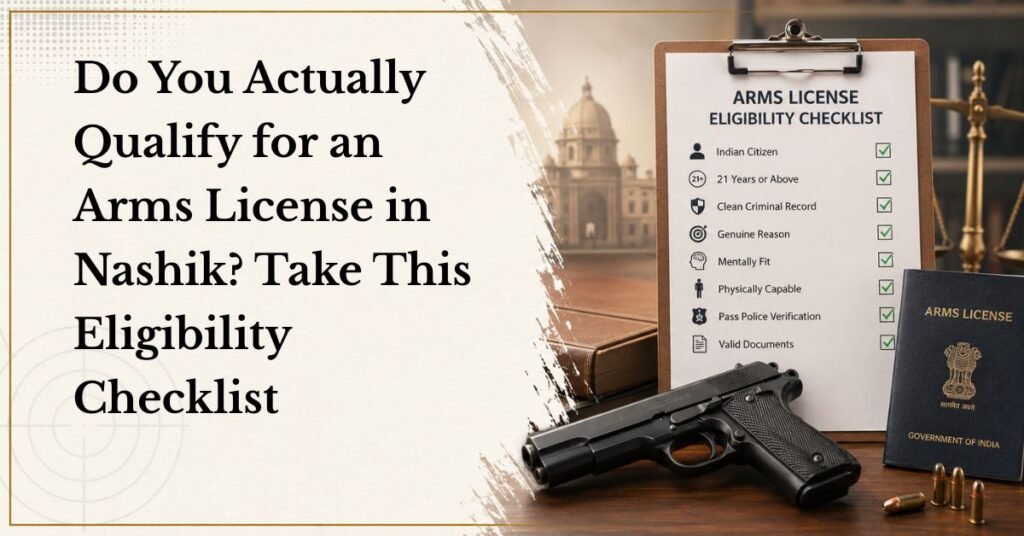
Quick Summary: Getting an arms license in Nashik isn’t about luck or connections; it’s about meeting clear legal, documentary, and character-based benchmarks under the Arms Act, 1959. This guide gives you a 20-point self-assessment checklist, busts common eligibility myths, and shows you exactly what to fix if you fall short so you apply with confidence instead of guesswork. If you have ever searched for “arms license eligibility in Nashik” and come away more confused than when you started, you are not alone. Between conflicting information on forums, outdated blog posts, and well-meaning but inaccurate advice from acquaintances, most first-time applicants have no real idea whether they even qualify before they walk into a District Magistrate’s or Police Commissioner’s office. This guide fixes that. Below is a practical, honest, self-assessment checklist based on the framework of the Arms Act, 1959 and the Arms Rules, 2016, written in plain language, so you can evaluate your own eligibility before you invest time in the application process. Who Is Legally Eligible for an Arms License in India? Under Indian law, an arms license is not a right it is a privilege granted at the discretion of the Licensing Authority (typically the District Magistrate or Deputy Commissioner of Police, depending on your jurisdiction) after verifying that the applicant meets specific legal and procedural conditions. Broadly, to even be considered, an applicant must satisfy these baseline requirements: Age: The applicant must generally be 21 years or older. Exceptions exist in limited circumstances, but minors cannot independently hold a license. Sound mind: The applicant must not have been declared of unsound mind by a competent court or medical authority. No disqualifying criminal history: The applicant must not have been convicted of an offence involving violence, moral turpitude, or under laws such as the Arms Act itself, NDPS Act, or similar statutes. No pending criminal proceedings of a serious nature that would indicate a risk if a weapon were granted. Genuine and justifiable need: This is the single biggest filter. The applicant must demonstrate a real, specific reason for self-defence due to a credible threat, business necessity (jewellers, cash handlers), agricultural protection (crop or cattle protection from wildlife or theft), or professional requirement (security personnel, sports shooters). Not a threat to public peace or security: The Licensing Authority evaluates whether granting a license could endanger public safety. Compliance with local police verification: A clean report from local police, including character and antecedent verification, is mandatory. Meeting these conditions does not guarantee approval, but failing even one of them makes rejection almost certain. The Complete Self-Assessment Eligibility Checklist Answer each question honestly with a Yes or No. This is the same type of scrutiny a Licensing Authority and a verifying police officer will apply to your file. Section A: Basic Legal Eligibility Are you at least 21 years of age? (Yes/No) Are you an Indian citizen? (Yes/No) Do you have a permanent or long-term residential address within Nashik, with valid proof? (Yes/No) Have you never been declared of unsound mind by a court or certified medical authority? (Yes/No) Do you have no conviction for any criminal offence involving violence, moral turpitude, or arms-related violations? (Yes/No) Do you have no ongoing serious criminal case, FIR, or preventive action registered against you? (Yes/No) Have you never had a previous arms license suspended, cancelled, or revoked due to misconduct? (Yes/No) Section B: Genuine Need Assessment Can you clearly explain, in writing, why you need a firearm (self-defence, business, agriculture, sport, or profession)? (Yes/No) If claiming a threat to life, do you have supporting evidence such as a police complaint, FIR, or documented threat? (Yes/No) If applying as a business owner, jeweller, or cash handler, can you show proof of business ownership, turnover, or cash-handling volume? (Yes/No) If applying as a farmer, do you own or lease agricultural land, and can you demonstrate wildlife or security-related risk to crops/livestock? (Yes/No) If applying as a security professional, do you hold a valid employment or contractual document from a recognised security agency or organisation? (Yes/No) Section C: Character and Community Standing Are you free from habitual alcohol or substance-related complaints on police record? (Yes/No) Have you maintained a stable residence (not frequently shifting without documentation) for a reasonable period? (Yes/No) Are you currently employed, self-employed, or able to demonstrate a legitimate source of income? (Yes/No) Do you have at least two credible references/witnesses who can vouch for your character during police verification? (Yes/No) Section D: Procedural Readiness Do you have access to your identity and address proof documents (Aadhaar, PAN, voter ID, etc.)? (Yes/No) Are you willing and prepared to undergo police verification, including a home visit? (Yes/No) Are you free of any pending litigation that could affect your character certificate? (Yes/No) Are you prepared to specify the type of weapon and its intended use accurately in your application? (Yes/No) How to interpret your answers: If you answered “No” to any question in Section A, you are currently ineligible and must resolve that issue before applying. A “No” in Sections B, C, or D does not always mean disqualification, but it significantly weakens your application and should be addressed first. Common Reasons Applicants Become Ineligible Understanding why applications fail is often more useful than knowing the rules themselves. The most frequent disqualifying or weakening factors include: Vague justification. Writing “for self-protection” without specific incidents, threats, or documentation is one of the most common reasons for rejection. Undisclosed criminal history, even for minor or old offences, discovered during police verification. Frequent change of address without updated documentation, which raises verification red flags. Unverifiable business claims for example, claiming to be a jeweller or cash handler without GST registration, shop licenses, or financial records. Poor local reputation or unresolved disputes, including property or family disputes that surface during the neighbourhood verification process. Incomplete or inconsistent documentation across application forms, affidavits, and supporting proofs. Applying for the wrong category of license, for instance, applying for a “self-defence” license when the actual need is business-related, which requires different
NDAL-ALIS Arms License Application Guide for Maharashtra
Summary: Understanding arms license eligibility in India is essential before applying, as strict rules determine who can legally own a firearm. From age and citizenship to background checks and valid reasons, every factor plays a crucial role in approval. This guide covers who can apply, required documents, key rules, and practical tips to improve your chances. If you’re planning to apply for a gun license, knowing these details can help you avoid rejection and delays. In recent years, personal safety has become a growing concern across India. From business owners handling large cash transactions to individuals facing potential security threats, more people are exploring legal ways to protect themselves and their assets. As a result, the demand for firearms through legal channels has seen a noticeable rise. One of the most regulated yet effective ways to ensure personal security is by obtaining a firearm through a valid arms license. However, not everyone qualifies for it. The government has established strict eligibility criteria to ensure firearms are issued only to responsible and eligible individuals. If you are planning to apply, understanding the arms license eligibility criteria in India is the first and most important step toward a successful approval. What is an Arms License in India? An arms license is a legal authorization issued by the government that allows an individual to acquire, possess, and carry firearms under specific conditions. It is governed by: The Arms Act, 1959 The Arms Rules, 2016 These laws ensure that firearms are controlled, regulated, and not misused. Who Can Apply for an Arms License in India? To apply for a gun license in India, you must meet the following eligibility requirements: 1. Minimum Age Requirement The applicant must be at least 21 years old 2. Indian Citizenship Only Indian citizens are eligible to apply for an arms license 3. Clean Criminal Record No criminal background No serious pending cases A clean police verification report is mandatory 4. Mental and Physical Fitness The applicant must be mentally stable No history of violent or unstable behavior 5. Valid Reason (Most Important Factor) You must clearly justify why you need a firearm. Authorities carefully evaluate this before approval. Common valid reasons include: Self-defense due to threat perception Business security (handling cash or valuables) Agricultural protection Professional risk Without a strong and genuine reason, approval chances are very low. Who is NOT Eligible for Arms License in India? Your application may be rejected if you fall into any of these categories: Individuals with criminal records Persons posing a threat to public safety History of violence or instability Substance abuse issues Applicants providing false or misleading information Authorities prioritize public safety, making background checks extremely strict. Valid Reasons for Arms License in India The reason for applying plays a crucial role in the approval process, as authorities carefully assess the necessity before granting permission. A clear and genuine justification significantly increases your chances of approval. Self-Defense: Individuals facing genuine threats to life or personal safety can apply under this category. Proper evidence, such as police complaints, threat perception, or risk factors can strengthen your application. Business Protection: Business owners dealing with high-value goods or large cash transactions, such as jewelers, traders, and cash handlers, may require firearms for security. Demonstrating financial risk and exposure helps justify the need. Agricultural Protection: Farmers, especially in rural areas, may need firearms to protect crops and livestock from wild animals. Supporting proof of land ownership and agricultural activity is often required. Professional Risk: Certain professions involve higher risk due to the nature of work or public exposure. Individuals in such roles can apply by clearly explaining the risks associated with their profession. A well-documented and clearly explained reason plays a key role in determining whether your application gets approved or rejected. Documents Required for Arms License in India To establish eligibility, the following documents are required: Identity Proof (Aadhaar Card, PAN Card, Passport) Address Proof Income Proof Passport-size photographs Medical certificate (if required) Character certificate Police verification report 📌 Ensure all documents are accurate, updated, and consistent. Police Verification Process Explained Police verification is one of the most important steps in the arms license process. What Authorities Check: Criminal background Residential verification Social reputation Threat perception Timeline: Usually takes 15 to 60 days, depending on the case A negative police report can result in immediate rejection. Common Reasons for Arms License Rejection Many applications get rejected due to avoidable mistakes: Weak or unclear justification Incomplete documentation Negative police verification No real threat perception Errors or inconsistencies in application How to Improve Your Eligibility & Approval Chances If you want to increase your chances of getting an arms license, follow these tips: Provide Strong Justification Clearly explain your need with supporting proof. Make sure your reason is genuine, specific, and backed by documents such as threat letters, business transactions, or risk exposure to strengthen your case. Avoid vague statements, as authorities give priority to well-documented and clearly explained applications. Submit Complete Documentation Double-check all documents before submission. Ensure there are no mismatches in details like name, address, or ID numbers, as even minor errors can delay or lead to rejection of your application. Organize your documents properly and keep both original and photocopies ready for verification. Maintain a Clean Record Avoid any legal or criminal issues. A clean background, good social reputation, and positive police verification report significantly improve your chances of approval. Even minor disputes or complaints can impact your application, so maintaining a good record is essential. Seek Expert Guidance Professional assistance can help you avoid mistakes and improve approval chances. Experts understand the process, documentation, and justification requirements, helping you present a stronger application. They can also guide you on handling police verification and responding to queries effectively. Understanding Arms License Eligibility in India Understanding the arms license eligibility criteria in India is crucial before applying, as every factor—from age and citizenship to justification and police verification—directly impacts your approval. A well-prepared application with accurate documentation and a strong, genuine reason